

Feel It,
Don’t Live
There
The first step after
a big setback
Elephant Conversations
The Confidence Coach
OCTOBER 8, 2026
In my last article, I told you about an experience I had in Dallas. The short version: in the process of trying to be the best public speaker I could be, I lost sight of myself… and crashed epically in front of an audience and panel of judges.
If you missed the article, click here to read it.
Everyone Has Their Version of Dallas
Your version of Dallas, or "the crash" as I like to call it, doesn't need a stage.
It might be the pitch that landed flat, putting yourself forward for something you really wanted and hearing no.
Or one of those family conversations where you and your sibling are arguing, your mother tells you both to be nice, and suddenly you're twelve again.
When something like that happens, most of us want to do one of two things: suck it up, get over it and prove we're fine, or disappear under the covers until further
notice.
I've done both.
The Hot Chocolate Moment
When I was about four, my dad taught me to ski.
One day I was so busy talking that I wasn't paying attention as we got on the chairlift. I slipped and missed it.
My dad was already on his way up, which meant I had to get on the next chair by myself.
I cried the whole way up. By the time I reached the top, I was so upset that they had to stop the lift so I could get off.
My dad was waiting for me.
He didn't say, "You're fine." He didn't point out that I should have been paying attention or ask me what I had learned.
He gave me a hug, let me cry, and took me for a hot chocolate.
I was absolutely certain I was never skiing again.
But, we went back out skiing. I was still a little nervous, but I got on the chairlift
with my dad.
I think about that moment now because we are so quick to demand the lesson from
ourselves while we are still metaphorically crying on the chairlift.
Sometimes the lesson can wait.
First, you get to have the hot chocolate moment.
Looking back, my dad seemed to know instinctively what took me years to relearn: you don't have to rush past the feeling to get to the lesson. Somewhere along the way, many of us lose that permission and start trying to manage the hard feelings instead: explain them away, minimize them, prepare our way around them.
I know I did.
The goal isn't to avoid the hard
feelings. It's to move through them
without getting stuck.
Part of me wanted to believe that if I handled things well enough, I could avoid that awful feeling of the floor dropping out altogether.
Of course, that isn't how life works.
What worked for me was much less dramatic.
I learned to say what was actually there: sad, embarrassed, disappointed, vulnerable, sorry for myself. Sometimes defensive too. "It wasn't my fault." "The mic cut out." "The judge was harsh." Fine. That can be part of it.
The goal isn't to avoid the hard feelings. It's to move through them without getting stuck.
Wallow With a Deadline
That's the first part: feel it.
The second part is just as important: don't live there.
I call it wallowing with a deadline, although the deadline depends entirely on what happened.
The point isn't to rush yourself or decide there is a correct number of days to be upset. It's to notice when having the feeling has quietly turned into feeding it.
I have a couple of tells.
One is that my inner critic moves in. She doesn't kick down the door. She brings a lamp, rearranges the furniture, and starts pulling out old files: "Great, while we're here, let's talk about every other time you screwed something up."
Another is when the people who love me start giving me that look that says, very gently, "Diane, we have heard this story before."
Am I Feeling This or Feeding It?
That's when I ask myself one question: Am I still feeling this, or am I feeding it?
There is a difference.
Feeling it is part of processing what happened and moving through it.
Feeding it keeps us stuck in it.
You don't have to leap off the couch, declare the setback a gift, and become a better
person by Tuesday.
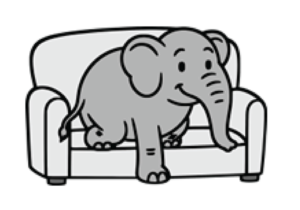
You just have to give yourself permission to feel what you feel, notice when feeling has turned into feeding, and then decide what comes next.
That question puts you at a crossroads. After every crash, there are two roads.
Which road you take is what we will cover in depth in my next article.

Ellie Asks:
What are you still feeling, and what
might you have started feeding?