


The $100,000
Painting Starts with Believing
You're Worth It
This is what happens when you
decide your work is worth what it’s actually worth.
BY JACKELYN GILL
WXN Media
SEPTEMBER 7, 2026
It takes only a second to lose yourself when you walk into Patricia Gagic's studio.
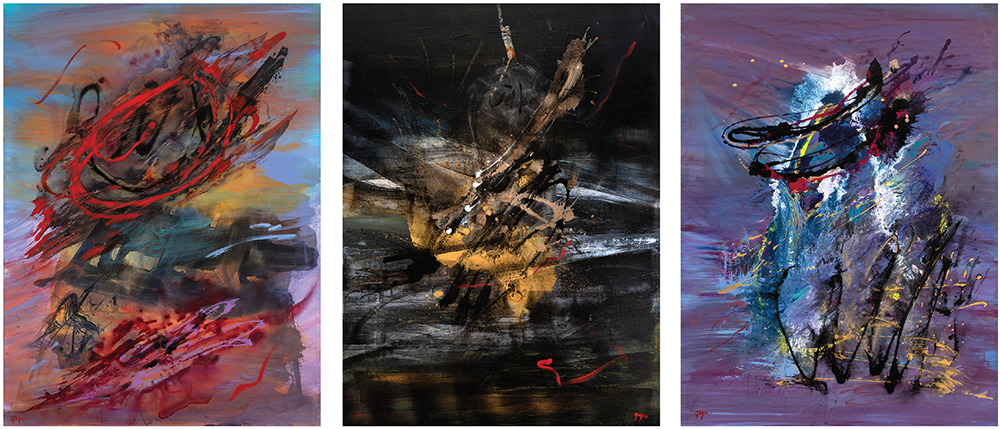
One work calls to you. Something abstract, contemporary. You're drawn to the collision of color, shape, and texture. Light and dark. You stand there just long enough to tease out layers of meaning before you notice the piece beside it. And the one beside that. On and on until you've lost track of time and your place in the room.
This is the work of a Gold Medal winner at the Salon National des Beaux-Arts at the Carrousel du Louvre. Of a Dame of the Order of St. George. An artist
whose own master has named her "Maestro."
"And if I didn't have my husband's income, I'd be penniless," she says.
For Patricia, the gap between recognition and reward is hardly one of talent. It’s an artist’s relationship to their own value. And it's a story she's finally decided to rewrite.
“I’m recognizing that I am an expert, I am a master, and I am the only one who is doing what I’m doing,” she says. “That has value.”
The Underpainting
The market rarely values the cost it took to get where you’re going. For
Patricia, the path demanded everything.
After a career in banking, her pursuit of art began with a professor asking her
to leave school. He felt her talent was beyond what a degree could offer. “I was
devastated,” she says. “I didn’t have any guideline around me. I knew this was
a floundering path that I was on. So I had to navigate it on my own.”
She didn’t know it then, but her next step was in France. And his name:
Dragan Dragic.
Patricia had seen one of his paintings on display—a white horse in
abstract—and she just couldn’t shake it. She and her husband booked a flight
to meet him, only to find, “He didn’t want to be a teacher. He didn’t want to
have a student.”
But when she showed up at his door with her work, that changed.
On her fourth day under his mentorship, he asked her to recreate one of his
pieces using just four pastel crayons. By morning. She’d never worked with
pastels before. “I stayed up all night. I destroyed the table because the shavings
from the pastel were everywhere,” she says.
When he asked her to attend a gallery opening in Avignon, she flew in on a
Thursday, stayed with him for fifteen minutes, and flew home.
"He tested me," she says. "Are you serious enough to do whatever it takes?"
She was. “The day he called me ‘Maestro’… nothing is as valuable as that
minute."
“I am now iconic. I am epic, I am a master, and I'm going to sell my paintings for $100,000.”
The Composition
So how do you put a price tag on the title, Maestro?
It’s a question Patricia grapples with. “After working so hard to become this, why don’t I feel that I deserve to actually be seen in that capacity?”
There’s a push and pull of sorts at play. Patricia describes her work as an expression of an inner pureness of love, kindness, and compassion. It’s the heartbeat behind each brushstroke.
“That's why I'm not desperately running all over New York for a gallery or anywhere else, because I've enjoyed and loved doing what I'm doing so much,” she says.
That's the thinking that got her here. But the next leap requires something different. “You have to go into selfish mode. I don't have a selfish bone in my body, and I now have to forget all the past thinking,” she says.
Thirty-seven years after meeting her mentor, after showing her work across Asia, Europe, and North America, after a career's worth of recognition that could fill a wall of its own, Patricia’s ready to say: “I am now iconic. I am epic, I am a master, and I'm going to sell my paintings for $100,000."
The Unveiling
Her ambition isn’t just personal. She wants her path to mean something for those who follow in her footsteps.
“Me playing in the lower market. I don't belong there any longer,” she says. “I’m in the market to make a significant difference. Myself, my story, the work that I’ve done, is allowing me to be by example for other women who want to take this type of a career path.”
It starts with her. And it starts with movement and belief in equal measure.
"Sitting is dormant," Patricia says. "I have played in that dormancy, and I don't want to do that any longer. It doesn't serve what I have accomplished."
And in her studio, surrounded by work that’s about to realize its true value, it's hard to argue anything different.